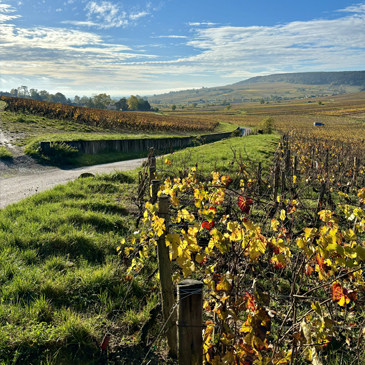
Domaine Comte Georges de Vogüé is an outstanding ambassador for one of the finest Burgundycommunes, Chambolle-Musigny. Georges de Vogüé is the epitome of Chambolle-Musigny, renowned for wines which offer richness and intensity in a hauntingly pure, dramatically aromatic translation of Pinot Noir. Chambolle-Musigny lies in the Côte de Nuits between Morey-Saint-Denis and Gevrey-Chambertin to the north and Vougeot and Vosne-Romanée to the south. Chambolle-Musigny is a commune capable of producing wines which really charm. They tend to be less densely-structured than those of its immediate neighbours yet, as a result the wines are more inclined to allow Pinot Noir to sing in its purest form. 'Elegance', 'finesse', 'nobility', 'perfumed' are all descriptions which flow from the pens of devotees, punctuated with others which infer understated, subliminal attributes, 'seductive', 'beguiling' and 'enticing' – hallmark Vogüé.
Domaine Comte Georges de Vogüé – the vineyards and the wines
Domaine Comte Georges de Vogüé accounts for 12.5 hectares of grands crus , premiers crus and villages Chambolle-Musigny. In grands crus they own 70% of Le Musigny itself, including the totality of Les Petits Musigny; and the tiny 0.6 ha designated as Musigny Blanc Grand Cru. In Bonnes Mares, with 2.7 ha they are the largest single proprietor, their parcels occupying the slope towards the south of the appellation.
Chambolle-Musigny Villages occupies 1.8 hectares, planted on limestone soils, the vines having an average age of 27 years. Production is a mere 417 cases on average, including wines from declassified premier cru holdings, Les Baudes and Les Fuées. The average ages of these vines are 54 years at Les Baudes, 45 years at Les Fuées.
Chambolle-Musigny 1er Cru accounts for only 0.6ha of the Domaine’s holdings, planted on clay-limestone soils. Despite the Domaine’s premier cru vineyards, their Chambolle-Musigny 1er Cru comes from declassified Musigny Grand Cru young vines, less than 25 years old.
Chambolle-Musigny Les Amoureuses 1er Cru is splendidly sited below Le Musigny. Geologically heavily faulted, it allows the roots of the vines to dig deeply for nutrients, increasing intensity whilst retaining an almost ethereal elegance. De Vogüé’s Les Amoureuses produces stunning wines, which can rival some grand cru wines. The Domaine holds 0.56 ha, planted on white oolite limestone. The average age of vines is 31 years and production is around 167 cases.
Bonnes Mares Grand Cru at the Domaine spans 2.7 ha of vines, with an average age of 29 years, planted on asteriated, fossil-rich limestone and white clay, terre blanche , visibly different from the soils in the north of the appellation which are darker and ferrous, terre rouge . Around 417 cases are produced of a rather elegantly-styled Bonnes Mares.
Le Musigny Grand Cru is a truly exceptional vineyard. The northern area is marginally the larger whilst the southern part is the monopole of Domaine Comte Georges de Vogüé. This contains the small, 0.6 hectare parcel of Chardonnay, on a mix of limestone and gravel, with which the Domaine elects to make their celebrated white wine. Due to a relatively recent replanting programme, the vines are currently on average, fourteen 14 years old. The Domaine deems this to be too young for grand cru and consequently declassifies the De Vogüé Musigny Blanc to Bourgogne Blanc. The De Vogüé Vieilles Vignes red Musigny holdings comprise 6.6 hectares, planted on limestone. The average age of vines is forty years while 2.8ha of younger vines are declassified to Chambolle 1er Cru to retain old vine complexity in the grand vin .
Domaine Comte Georges de Vogüé – the philosophy and the people
The philosophy at Domaine Comte Georges de Vogüé is based on a humble and respectful alliance between vineyard and man. It is generally acknowledged that the team of the latter, put in place in the mid 1980s by the late Elisabeth Baronne Bertrand de Ladoucette, daughter of the legendary Comte Georges de Vogüé has been a great success. The fundamental values of every aspect of the estate, vineyard, cellar and marketing lie in a respect for both the vagaries of nature and the specificity of the domaine’s vineyards.
The team encompasses three individuals – François Millet, Maître de Chai and Oenologue , who started in 1986; Jean-Luc Pépin, the supremely enthusiastic Sales Director, who joined in 1988; and Eric Bourgogne, Chef de Culture , who joined in 1996. All three now work under the direction of Claire de Causans and Marie de Ladoucette, grand-daughters of Comte Georges de Vogüé.
François Millet is a man of few words, yet possesses an unerringly poetic grasp of language when describing de Vogüé wines. François would agree vociferously, as would Jean-Luc Pépin and Eric Bourgogne, that strict vineyard husbandry and consequently rigidly-controlled yields are key to quality. It is rare however to extract his opinion on how such impeccable ingredients are translated in the finished wines. He will argue, quite rightly, that each vintage is completely different and that a formulaic approach is an arrogance. It is difficult even to persuade him to illuminate the specifics of one particular wine in a given year. François would do well in espionage.
Specifics are difficult to pin down due to a rare flexibility in the team and an open-minded attitude regarding decisions over de-stalking, maceration and fermentation, as well as the percentage of new oak, length of maturation before bottling and whether or not to rack or fine. One element is rigid however. There is but one holy grail. The whole team is united in seeking the purest translation of the vineyard ingredients within the context of each vintage.
Domaine Comte Georges de Vogüé – history
The origins of Domaine Comte Georges de Vogüé, one of the oldest estates in Burgundy, date back to 1450 when Jean Moisson endowed the church in Chambolle-Musigny. It was he who built the house, together with the cuverie and other buildings around the inner courtyard of the domaine. His grand-daughter offered, as dowry, the nucleus of the de Vogüé domaine, whose stewardship, after some twenty generations, continues with Claire de Causans and Marie de Ladoucette, grand-daughters of Comte Georges de Vogüé who inherited the estate in 1925 and ran it for over fifty years. His daughter Elisabeth, Baronne Bertrand de Ladoucette, established the new dynamic team which exists today.
Horse ploughing at Domaine Comte Georges de Vogüé
Domaine Comte Georges de Vogüé courtyard
Domaine Comte Georges de Vogüé Team ... complete with name!
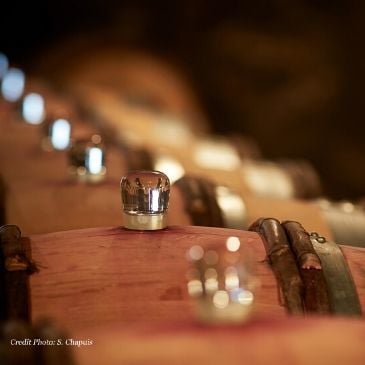
Domaine Comte Georges de Vogüé crest on an oak barrel