The privately-owned German wine estate, Schloss Schönborn, has some 650 years of history and experience under its belt, during which time the Schönborn family has amassed some spectacular sites. The philosophy which underpins the Schloss Schönborn estate, in all it does, is the pursuit of quality. The Schönborn family were founder members of the Verband Deutscher Prädikats- und Qualitätsweingüter (VDP), the Association of German Quality Wine Estates. The issue of quality is important. It is a sad but undeniable fact that many people deny themselves some of the world’s finest wines – erroneously believing that all German wine is sweet and invariably nasty. Good German wine is phenomenal and fine Riesling exquisite. One of the world’s most noble varieties, it is stunning in youth and ages well. The Schloss Schönborn team are very diligent in both pursuing excellence and communicating it.
We were delighted and honoured to gain exclusive distribution of the Rhine wines of Schloss Schönborn in the United Kingdom. We loved the wines and were eager to introduce them to as many people as possible, though we prepared ourselves for the challenge ahead, namely, disabusing an alienated audience of their preconceptions. Why, in a world so captivated by wine, so open to new discoveries, is a historic producer so mistrusted and yet, amongst the cognoscenti, notably the trade and press, so revered.
The complaints are, unfortunately, not without foundation. It is arguable who is to blame but an insatiably thirsty market, allied to questionable legislation, encouraged bulk production of, at best, very ordinary wines, undercutting specialists who have stunning wines to offer. Estates such as Schloss Schönborn continue to fly a much more positive flag and their wines bear eloquent testimony to quality winemaking.
German vineyards, global warming not withstanding, are absolutely at the limit, almost beyond the limit of where grapes will ripen. This is both a constant threat and a magnificent opportunity as vine and man both struggle to balance two essential but dangerous elements in fine wine – acidity and sugar. Too much or too little of either is disastrous. When acidity is mentioned we remember functions past, where unsuspecting pot plants become victim to discarded, paint-stripping plonk. Think however of a fresh home-grown raspberry or strawberry – oozing vitality – against a flabby jamming variety, flat and uninteresting. We need acidity for freshness. Similarly, sugar has rather fallen from favour yet, here, in the best wines, the sweetness is grape ripeness, not sugar per se. Added sugar is indeed one of the problems further down the quality ladder. When ripeness and acidity come together harmoniously however, the results can be electric.
The vineyard sites owned by Schloss Schönborn are perfect in achieving this end, at every level. The sweetness debate becomes more complicated as, ostensibly, the degree increases with each quality and price level. It is important to remember that sweetness is not the issue, but, the degree of ripeness and the necessary complementary acidity which makes it work. This depends on nature, microclimate and plant husbandry, not the addition of sugar.
Top German wines bearing the QmP label, Qualitätswein mit Prädikat (wine with a specific attribute) may not have added sugar, even though that is standard practice even in many hotter parts of Europe. Working to achieve quality is extremely labour intensive, especially as steep slopes do not allow for machinery, but when looking for optimum ripeness, individually ripe bunches (auslese) and even individual grapes (beerenauslese) must be plucked by skilled and experienced hands, working on precipitous slopes where balancing is difficult.
Schloss Schönborn – the wines
Schloss Schönborn Rheingau Estate Riesling At the first level, Rheingau Riesling, the easiest to pronounce, is an attractive introduction. It is a blend from different vineyards, all estate owned. As with other wines in the collection it makes an excellent aperitif but is also a fabulous complement to food, notably awkward ingredients, smoked dishes and delicate spice – also a perfect lunchtime wine, being lowish in alcohol.
Schloss Schönborn Erbacher Marcobrunn Riesling Erbacher Marcobrunn lies midway between Hattenheim and Erbach and is one of the most highly-prized single vineyards in Germany, with Schloss Schönborn owning some 2.2 hectares from a total of 5.5. The family really established the reputation of this vineyard worldwide, attracting such widely different enthusiasts as Goethe, Hindenburg, Jefferson and Eisenhower. We have two wines from the estate which differ essentially in the degree of natural ripeness when picked. Kabinett is the lighter of the two whilst with Auslese single bunches are picked late to ensure a sublimely unctuous wine, bottled in 50cls. Both age well.
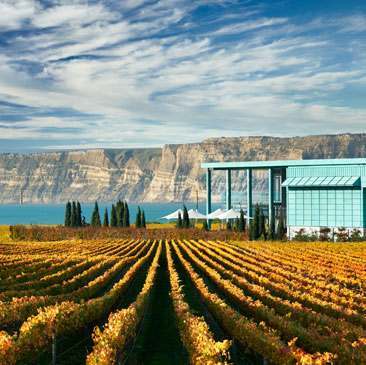
Schloss Schönborn Hattenheimer Pfaffenberg Riesling Spätlese Along the Rhine, in neighbouring Hattenheim, Hattenheimer Pfaffenberg is a Schloss Schönborn monopole, a south-facing six hectare plot, surrounded by a wall. The wall, soils and aspect make for a unique terroir and a very fine, elegant, late picked (spätlese) style.
Periodically we review our allocations from the Schloss Schönborn portfolio. The wines are stunning – excellent ambassadors for the Rheingau. Schloss Schönborn is managed by Graf Paul Von Schönborn, a banker, who completed his studies in the United States. Running a family estate which dates back to 1349 is quite a responsibility, very lightly borne.