


Introduction
«Jean-Marc et Anne-Marie Vincent sont de grands vignerons qui concentrent la majeure partie de leurs efforts dans leurs vignes,…» La Revue du Vin de

«Jean-Marc and Anne-Marie are great winemakers who spend most of their time & energy in their vineyard,…»
La Revue du Vin de
The energy and the passion of Anne-Marie and Jean-Marc Vincent is so captivating that what was to be an hour-long appointment, ended up lasting three hours. I left the couple after eight o’clock on a dark night, having started the vineyard tour in broad daylight.
Staying away from superlatives, Domaine Jean-Marc Vincent transcends the Santenay appellation as we know it and shows the real potential of this terroir which was held in high esteem at the time of Jules Lavalle.*
Their secret is a story of hard manual labour, respect for Nature, learning from past generations and a bit of daring. The result is terrific wines that you will want to enjoy as often as possible.
We are proud to be the exclusive agent for the Singapore market. And this is our first release En Primeur.
THIBAUT MATHIEU
MANAGING DIRECTOR, CORNEY & BARROW ASIA
JANUARY 2024
* Jules Lavalle (Jean was his real first name, 1820-1880) was a physician and scientist who wrote the first classification of the Burgundy vineyard and wines in 1855.
HISTORY
The domaine was first created by Jean-Marc’s grandfather, André Bardollet-Bravard, in the mid-20th Century.
The six hectares of vines were planted between 1949 and 1951. So today the Vincents work with vines of a venerable age (60 years on average). The heart of the domaine is in Santenay, producing both red and white wines. They own plots in the villages of Auxey-Duresses, Puligny-Montrachet and Montagny as well.
Jean-Marc Vincent founded the eponymous domaine with his wife Anne-Marie in 1997 to rescue the family estate before it got sold following Andre’s passing away and the intricacies of French inheritance laws. Jean-Marc’s father had not taken over from his own father when he retired in 1970 and the vineyards were rented under métayage contracts. The duo first made wines from 3.5 hectares, that they got back in bad condition due to poor management and care. The first vintages were difficult, with ample time spent on returning the vineyards to their former glory. They patiently waited for all the métayage agreements to lapse, finally regaining control on the whole six hectares. The first vintage of the new established Domaine Jean-Marc Vincent was 1998.
Today Jean-Marc Vincent is considered among the best of the appellation and the wines would get even more traction had the village of Santenay the same recognition as neighbouring Chassagne, Puligny or Meursault. It was certainly different in the 19th century when one read the reports of Jules Lavalle. Santenay was regarded as a vineyard producing highly sought-after wines, deep, precise and complex. Certain cuvées were rated at today’s equivalent of premier or exceptional crus. Nowadays Santenay remains the fourth largest planted appellation of the Cote d’Or.
Some of the many reasons for the success of the domaine are found in the vineyards. Jean-Marc, a biology graduate with a Diplôme National d’Oenologue (the highest qualification in winemaking in France), introduced new practices there and in the winery in the quest for excellence.
Jean-Marc and Anne-Marie introduced high density planting, under advice from their friend Olivier Lamy (of Domaine Hubert Lamy), to be at 10,000 to 15,000 vines per hectare. This technique forces the vines to strive for nutrients, resulting in berries of higher quality. They changed the vine and canopy management to help the vineyards adapt to warmer vintages. And they moved to organic farming in 2003.
Jean-Marc follows his grandfather in other areas, drawing inspiration from old books when secular expertise prevails. His ultimate goal remains to produce great wines in the most natural way.
In the cellar, improvements were made around using gravity to move the must and wines. Jean-Marc favours whole bunch fermentation for the reds, slow pressing for the whites and extended time on lees. For both colours, each winemaking step is done over a prolonged period, from maceration to fermentation to ageing. The latter takes place in mostly old oak. The domaine strives to craft wines which express their terroirs.
VINEYARD & CELLAR

Jean-Marc has fond memories of working with his grandfather, during the summer holidays at the estate. Some of what he does today is inspired by what he learnt there. He takes inspiration from proven good practices. Anne-Marie mentioned an old book on delayed pruning, written in 1874, that is on her husband’s bedside table. But modern techniques have their place in this operation too.
The first years were tough with a large proportion of vineyards to restore (in some plots, a third of the vines were missing) and to wait until the ceps (vine trunks) were matured enough to produce grapes good enough for winemaking. This takes a minimum of three years. They chose massal selection to replant the empty rows, selecting cuttings from their existing vines.
Anne-Marie and Jean-Marc spend most of their time in the vineyards tending the vines manually and as naturally as possible. Their motivation is high quality grapes at harvest. And the exceptional wines they craft from this premium crop. The style of their wines is purity and terroir expression.
They believe in the school of high-density planting (10,000 to 15,000 vines per hectare). The concentration of the plantings forces the vines to extend their root networks as deep as possible to capture the nutrients they feed on. This improves the quality of the berries and the resistance of the vines. Jean-Marc believes that under this method, high-quality grapes can be produced from vines as young as 7-8 years of age, similar to the quality level of 30-40 year-old vines planted at lower densities.
The domaine has adopted high trellising, in which the vine canes are left untrimmed. The Pinot Noir canes are breaded, then rolled over on the last wire, in an arched shape. This controls the vine’s vigour and restrains the size of the berries. For the Chardonnay, the canes are cut, but high (over 1.4~1.7m) and retain heavy foliage. This creates natural protection against the sun, produces berries with good acidity and bunches that are well aerated. The domaine does a late hard pruning in the spring (March), another of their techniques to control yields. This helps to limit the risk of frost. All these techniques reduce stress naturally in the vineyard during the hot years that are now so common.
Most of the work in the vineyard is done manually and when they need machines, the Vincents drive skilfully three chenillards (caterpillar-like tractors as big as traditional lawn mowers). These machines are light and don’t compact the soil. They can work under and in between the vines when needed, without damaging the roots and the small trunks. They stopped using heavy machines like the classic enjambeurs (which straddle the vine rows) a long time ago.
Organic farming is the rule, resulting in vines better equipped to fight climate change. To keep a healthy soil, Jean-Marc cultivates cover crops between the rows for 7-8 months of the year. He ploughs only once, early in the vintage, to aerate the soil. He adds some organic compost once in the autumn.
As expected, harvests are done manually when the grapes reach optimal maturity. A severe sorting is carried out in the vineyards, to only bring perfect bunches to the winery. All in all, Jean-Marc estimates 1,000 hours of manual work per hectare at the estate. This is the price of high quality grapes.
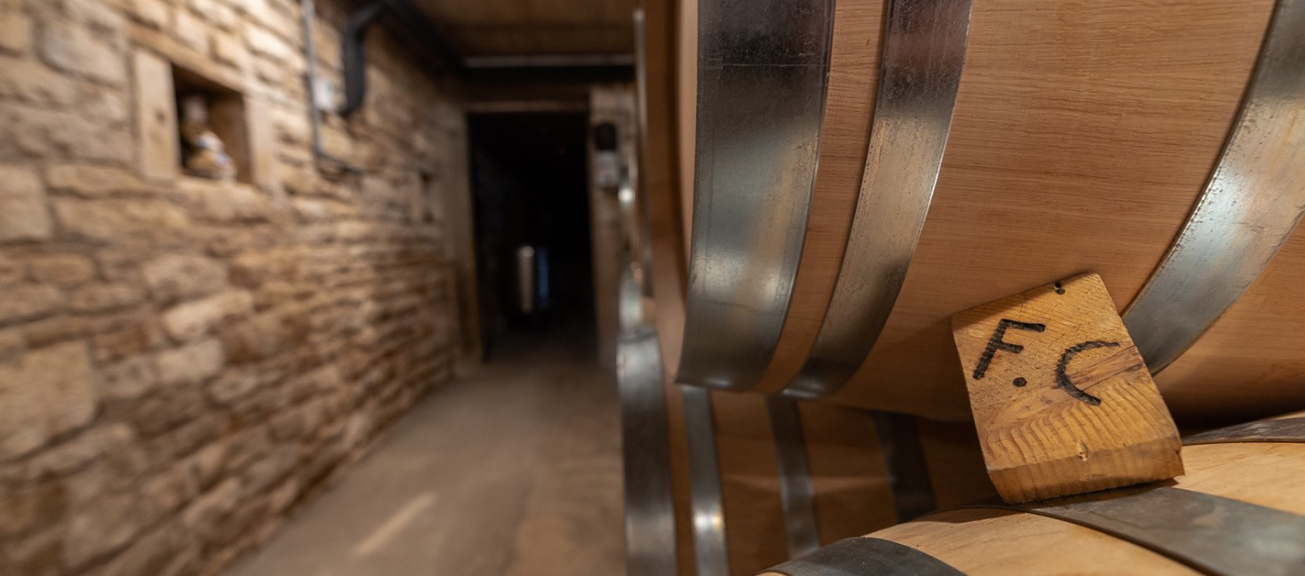
In the 14th Century winery, above a picture-perfect vaulted underground cellar, the layout is arranged to move grapes and must by gravity and limit the usage of pumps. I can report that it is a very cool to cold place…
Pinot Noir berries are brought in whole and undestemmed, then placed directly into concrete tanks. A slow maceration and fermentation with indigenous yeast follow. Ageing takes place in increasingly large format casks (500L to 600L), 20% new for a minimum of 15 months and with no racking. The must spends six months in stainless steel vat prior to bottling, without filtration.
The Chardonnay grapes are slowly pressed, before transfer to barrels for fermentation. The white wines age in 15% new oak for a long time too. They are racked 3-4 times per month for the first 5-6 months then left still on lees until bottling.
All wines go to stainless steel tanks for six months before bottling. There is no fining. No SO2 is added during fermentation but a little is used before bottling.
Long ageing in large foudres (bigger barrels) promotes stability and balance thanks to measured oxygenation. Jean-Marc says it is fine for his high-quality wines from ripe grapes to age for up to 18 months.
Jean-Marc’s references are the old vintages of the ‘40s, ‘50s and ‘60s made by his grandfather and tasted with him.
THE 2022 VINTAGE
2022 was hot. Temperatures peaked in a series of three heatwaves, in mid-June, mid-July and early August.
However, there was also rain, at the beginning and end of June, with regular showers from mid-August through to harvest. A six-week dry period, including the whole of July, pushed some younger vines into temporary shut-down. Nonetheless, the result was a vintage of expressive ripe fruit, with balancing freshness and moderate alcohol.
Winter saw some freezing temperatures in January and mid-February but, on the whole, was milder and drier than average. March was cool, slowing down the start of growth. After the first tender shoots emerged in early April, a cold front from the north heralded the habitual period of frost. This first hurdle of the season, which proved so devastating in 2021, was cleared in 2022. Four nights of frost in the period between 3rd and 11th April left minimal mark, most vines still being at the ‘bud-in-cotton’ or pre-budbreak stage.
Warm spring weather from mid-April resulted in rapid growth in the vineyards. Flowering started around 20th May and was over by month-end, going through quickly thanks to the dry, warm conditions, putting the season around a fortnight ahead of average (until the April growth spurt, it had lagged behind).
June alternated between heat and rain, whilst fortunately avoiding the fungal diseases which can become a blight under such conditions. 75mm of rain fell from 21st to 26th June. July saw the peak of the summer heat and was totally dry.
The effect of showers and cooler temperatures in mid-August was immediately apparent in the vines, providing the boost needed to get them through to harvest at full maturity. Harvest at the domaine started on 27th August, with Gravières Blanc, and finished on 6th September. Jean-Marc remarked that on 4th September, it was still 28°C!

THE WINES
WHITE WINES
The wines in this year’s release are from the 2022 vintage, with the exception of the red Santenay Gravité, which is released a year later and is therefore from 2021.
BOURGOGNE BLANC
The domaine’s Bourgogne Blanc comes from 0.30 hectares of clay-limestone soils, in Santenay and Meursault. These are relatively young vines, just over a decade old. Textured, gently honeyed white peach fruit lifted by fresh acidity. A great earlier drinker.
Corney & Barrow Score 17-17.5
Recommended drinking from 2025–2028
SANTENAY BLANC LES VIGNES DENSES
This is a blend of three parcels, totalling 0.74 hectares. The vines are young: just 7-8 years old, and are planted at a high density (hence the name) of 14-15,000 vines per hectare. Flinty mineral aromas, with fine stone fruits. The pear- and peach-fruited palate is supple and giving, with great chalky tension and marked dry extract. Vinified in large 500L barrels, as are all the whites.
Corney & Barrow Score 17.5 -18
Recommended drinking from 2025–2030
AUXEY-DURESSES BLANC LES HAUTÉS
Two old-vine parcels close to Les Vireuilles, totalling 0.9 hectares, planted in 1937, of which just 0.6ha are in production at the moment. These vines are planted at 15,000 vines per hectare and produce a lot of small grapes. Precise stone-fruit aromatics, with flinty minerality and a marked salinity to the nose. The white peach-fruited palate is racy, with momentum, wet-stone minerality and chalky minerality persisting on the finish.
Corney & Barrow Score 18
Recommended drinking from 2025-2030
SANTENAY BLANC 1ER CRU LE BEAUREPAIRE
This comes from a half-hectare holding of 22 year-old vines. There was an acacia forest here before, which apparently accounts for the plentiful soil nutrients. One part is particularly magnesium-rich, with small fossils. The other, which is currently out of production, has white marne soils, similar to Chablis. Jean-Marc commented that Beaurepaire tends to retain fresh acidity, but with a ripe acid profile. Fine flinty-mineral nose. The palate is supple and giving, the ripe stone-fruit strikingly present, balanced by a backbone of fresh acidity. Real ageing potential here.
Corney & Barrow Score 18+
Recommended drinking from 2027-2032
SANTENAY BLANC 1ER CRU LES GRAVIERES
This comes from two tiny plots of vines planted at high density: 17,000 vines per hectare. It has an endearing nose of fine white peach fruit, warm pastry and flinty minerality. The palate’s delectable peach and apricot fruit is ripe and balanced out by a seam of fresh acidity and fine chalky extract. Substantial but so fine, brilliant. White flower perfume persists on the long finish.
Corney & Barrow Score 18.5
Recommended drinking from 2027-2032

RED WINES
The wines in this year’s release are from the 2022 vintage, with the exception of the red Santenay Gravité, which is released a year later and is therefore from 2021.
SANTENAY VIEILLES VIGNES
Dark peppery aromas, with exotic spices from a degree of whole bunch fermentation. The palate has density and gravitas – blackberry, liquorice and bitter cherry fruit. A wine of great immediacy and energy.
Corney & Barrow Score 17 - 17.5
Recommended drinking from 2025–2029
SANTENAY 1ER CRU LES GRAVIERES
Jean-Marc and Anne-Marie have two parcels in Gravières, totalling 0.75 hectares. The vines here are 75 years old. Dark cherry and liquorice aromas. The palate offers expressive ripe forest fruits and wintery berries, framed by fine, firm tannins. Recently suplhured when tasted in autumn 2023 but delicious nonetheless.
Corney & Barrow Score 17.5+
Recommended drinking from 2025–2032
SANTENAY GRAVITÉ 2021
Due to its extended barrel ageing, this is the only wine in the offer released a year behind – it is the 2021 vintage. Gravité is a selection from Passetemps, Gravières and Santenay Vieilles Vignes, averaging 40% village and 60% premier cru fruit. The vines are 70-75 years old on average. A impressive, powerful wine of sweet dark berry fruit, a hint of confit, dark cherry and bitter chocolate. Jean-Marc explained how a degree of fanleaf in this vineyard results in naturally small yields and concentrated berries, a similar effect to millerandage.
Corney & Barrow Score 17.5 - 18
Recommended drinking from 2025–2032+