


Introduction
Villages
MÂCON-VERZÉ
Verzé is a village to the north west of Mâcon. Sheltered by hills, it enjoys views over the Saône river, a tributary of the Rhône.
MaconnaisBurgundy
MaconnaisBurgundy
An important district of Burgundy on the River Saône producing dynamic wines. The production is swayed towards white wine, with 80% of the region being planted with Chardonnay, whilst the reds are largely dominated by Gamay.
The quality hierarchy begins with Mâcon, goes up to Mâcon-Villages and the top status is reserved for wines that hail from 26 specified communes, which can hyphenate their village name after Mâcon. The latter two levels are reserved for white wine only.
Lying between Beaujolais to the south and Côte Chalonnaise to the north, the Mâconnais benefits from more sun, less rain and less frost risk. The terrain alternates between hilly panoramas and tremendous cliffs interspersed with farmland.
Domaines Leflaive >
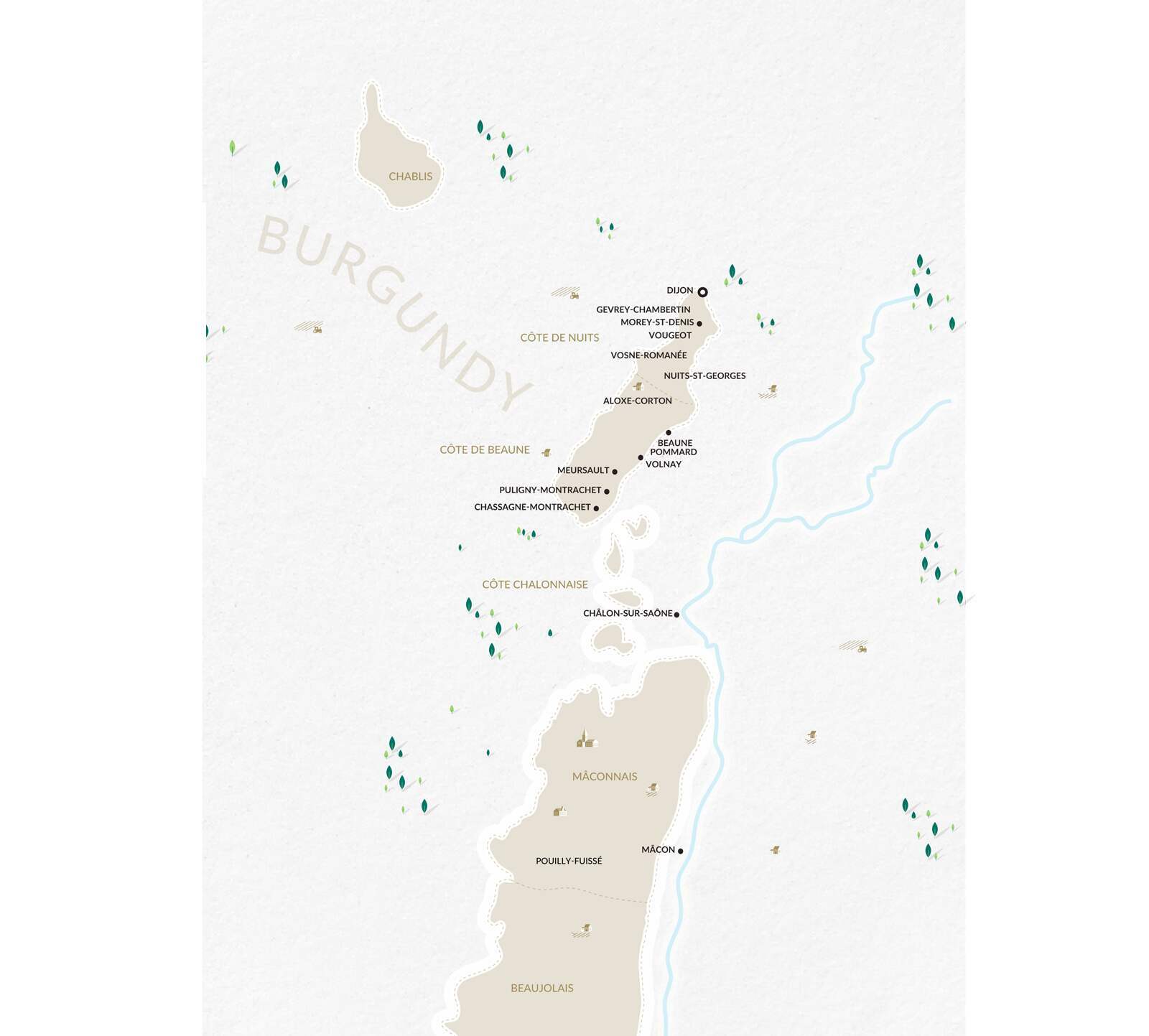
Burgundy Map
Exclusive Region
Chablis
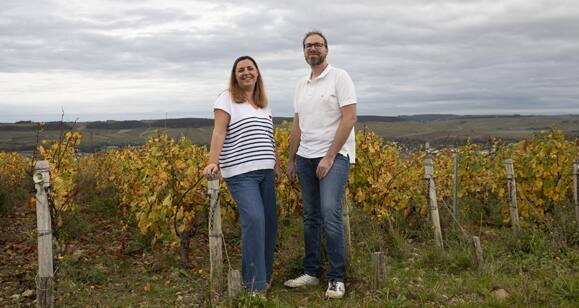
Chablis is unmistakeable for its distinctive profile - dry, flinty, mineral, steely – that sets it apart from the classic white Burgundies of the Côte d’Or. This stylistic difference is perhaps unsurprising, given that the Chablis appellation is geographically separate, 130km northwest of Beaune, a picturesque 1.5 hour drive through the mountainous massif de Morvan. In fact, in some senses Chablis might be considered closer to Champagne, in its location, climate and style.
The appellation comprises a four-level hierarchy: Chablis Grand Cru, Chablis 1er Cru, Chablis and Petit Chablis, classified over time, and spanning different terroirs and price tags.
Côte de Nuits
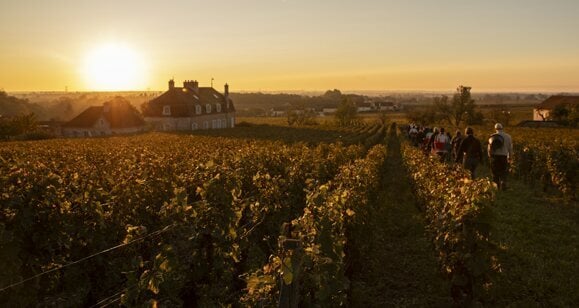
The northern half of the Côte d’Or escarpment, the Côte de Nuits gets its name from one of its most famous villages: Nuits-Saint-Georges. Stretching 20 kilometres from Dijon to Nuits-Saint-Georges and expanding between 200-800 metres wide, this illustrious region covers 3600 hectares.
Within this, it boasts an impressive number of grand crus vineyards where the Pinot Noir grape rules supreme. Travelling through the region, you will see the slopes adorned with vines, periodically broken up by barren, rocky outcrops or limestone quarries in the south. The soils lower down the slopes are more fertile, whilst narrow strips higher up the hillsides provide exceptional terroir, albeit with less vine vigour.
Although reputed for its red wines, the Côte de Nuits also produces a small amount of high-quality whites too. Simply put, it is home to some of the greatest Pinot Noirs in the world.
Côte de Beaune
In the southern half of the Côte d’Or, the appellation of Côte de Beaune is rugged and picturesque. Owing its name to the city of Beaune at the heart of the area, it is almost twice the size of the Côte de Nuits, with around 6000 hectares under vine.
Renowned for producing some of the region’s greatest white wines, including Meursault, Puligny-Montrachet and Chassagne-Montrachet, among others, almost all of Burgundy’s white grand crus can be found here. Each expresses intensity and complexity, offering some of the most exceptional Chardonnays in the world. The Côte de Beaune is also a source of very fine Pinot Noir, these red wines tending towards delicacy and finesse.
Côte Chalonnaise
Nestled between the Côte d’Or and Mâconnais, the Côte Chalonnaise produces both red and white wines from Pinot Noir and Chardonnay. Its undulating landscape offers a mixture of limestone, gravel and clay soils, similar to that of Côte de Beaune, although it enjoys fractionally more sunshine.
There are five village appellations: Mercurey and Givry produce mostly red wine with small quantities of white, Montagny is solely white, Rully offers both red and white along with some sparkling wine production, and Bouzeron uniquely has its own appellation for white exclusively made from the Aligoté grape.
Maconnais
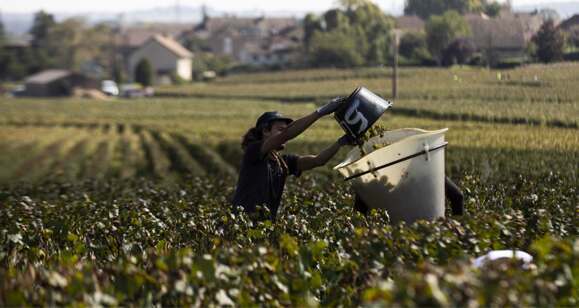
An important district of Burgundy on the River Saône producing dynamic wines. The production is swayed towards white wine, with 80% of the region being planted with Chardonnay, whilst the reds are largely dominated by Gamay.
The quality hierarchy begins with Mâcon, goes up to Mâcon-Villages and the top status is reserved for wines that hail from 26 specified communes, which can hyphenate their village name after Mâcon. The latter two levels are reserved for white wine only.
Lying between Beaujolais to the south and Côte Chalonnaise to the north, the Mâconnais benefits from more sun, less rain and less frost risk. The terrain alternates between hilly panoramas and tremendous cliffs interspersed with farmland.
Beaujolais
In the southernmost part of the Burgundy region, Beaujolais champions the Gamay grape. Although traditionally renowned for light and fruity reds made popular by the emblematic Beaujolais Nouveau, the arrival of established Burgundian producers to this area has meant a move toward quality-focussed wines with a more concentrated style.
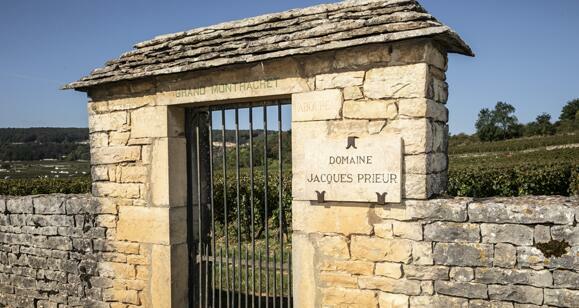
We work with a couple of Beaujolais producers who are based within two of the most famous ten named crus: the Labruyère family in Moulin-à-Vent (who also own Domaine Jacques Prieur in Meursault) and the Lafarge family, originally from Volnay but whose holdings now stretch to Fleurie.
Both families stress that they make wines of their respective appellations over ‘Beaujolais’ – terroir-driven and bold with friendlier price tags than in the Côte d’Or!